
Rim joists, foundation walls and crawl spaces
Basement & Crawl Space Insulation in Staten Island, NY
Cold floors, musty smells and drafts start below. We seal and insulate the lower level with water in mind.
- Free on-site estimates
- Written quote showing foam type, thickness and R-value for each area
- Moisture, leaks and flood history checked before anything is covered
The Lower Level on Staten Island
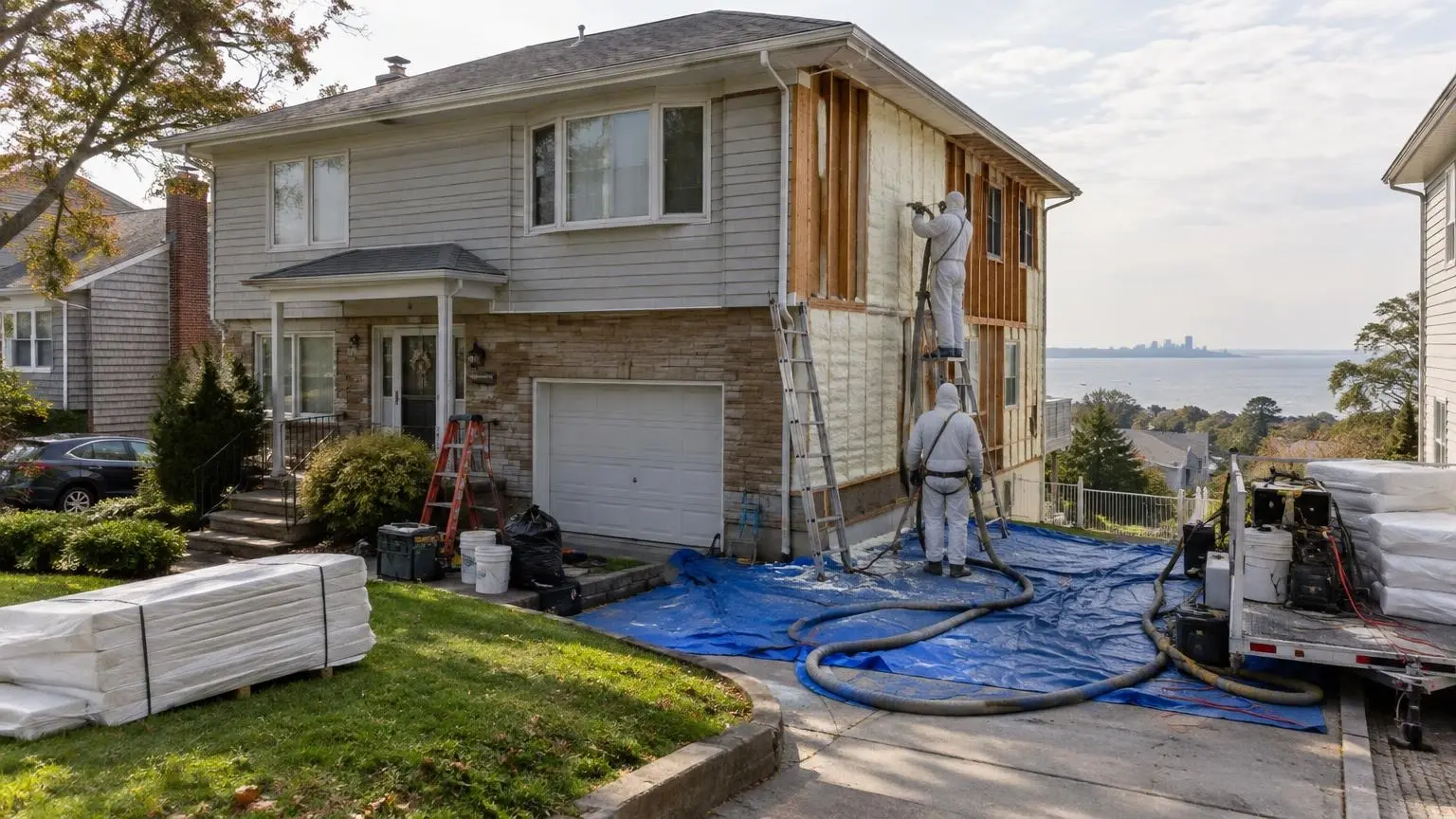
Basement and crawl space insulation on Staten Island starts with a question most places skip: has this space taken water? Low-lying parts of the East and South Shore flooded in Hurricane Sandy, some neighborhoods flood after heavy rain, and older bungalows often sit over shallow crawl spaces with dirt floors. We look at moisture first, then seal and insulate the rim joist, foundation walls or crawl space so the floors above stay warmer and the house stays drier.
The rim joist
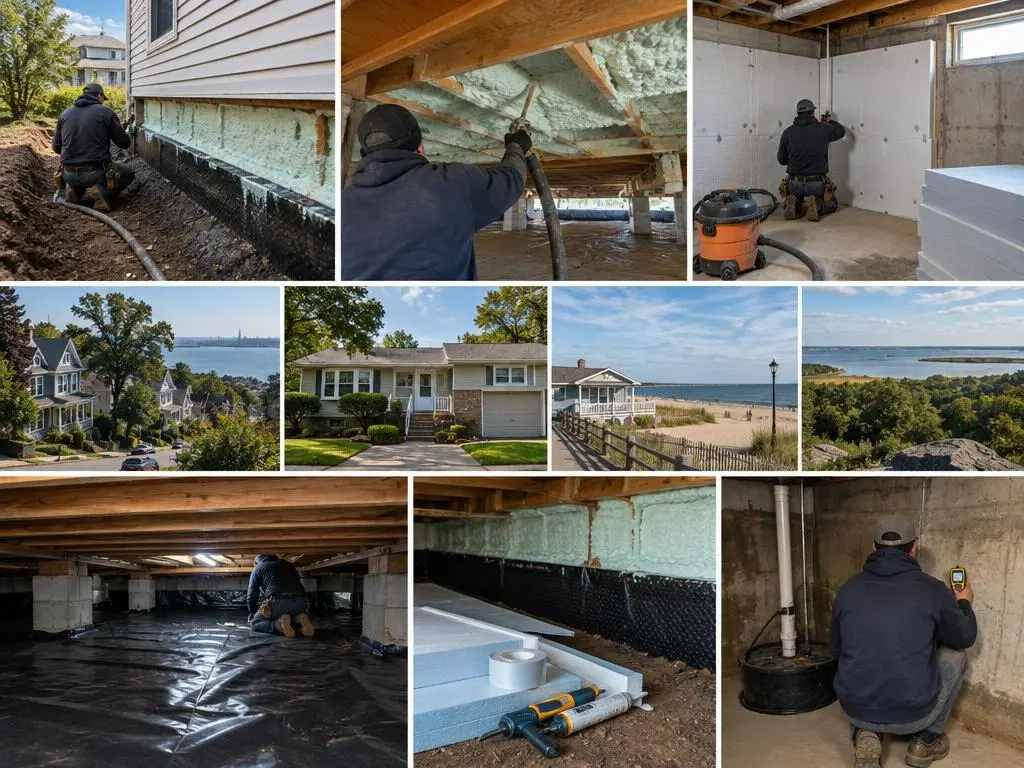
The rim joist is the band of framing that sits on the foundation wall and carries the floor. In most houses it is bare wood or has a loose piece of fiberglass stuffed against it, and it runs around the whole perimeter. Cold air comes in there all winter, and humid air reaches cold wood in summer. Closed-cell spray foam sprayed a couple of inches thick seals and insulates it in one pass. It is usually the quickest comfort fix in a basement and one of our most common jobs.
Basement walls
The 2025 NYC Energy Conservation Code lists R-15 continuous, R-19 in a framed cavity, or R-13 cavity plus R-5 continuous for basement walls in Climate Zone 4A. If you are finishing a basement, the best time to insulate is before the framing goes up. Closed-cell foam or rigid board against the concrete keeps warm, damp indoor air from reaching the cold wall, which is where mold behind drywall usually starts. We do not recommend fiberglass batts pressed against bare concrete.
Crawl spaces
A vented crawl space under a bungalow or an addition pulls in humid outdoor air all summer. That air meets cool ground and framing and condenses, and the result is damp joists, sagging batts and a musty smell upstairs. The usual fix is to close the vents, lay a heavy vapor barrier over the ground, and insulate the crawl space walls with closed-cell foam. The code lists R-15 continuous or R-19 cavity for crawl space walls. Where a crawl space has to stay vented, often because it is in a flood zone and must let water through, we insulate the floor above instead and protect the insulation from below.
Flood zones and lower levels
FEMA's Technical Bulletin 2 says only Class 4 and Class 5 flood damage-resistant materials are acceptable below the base flood elevation in a special flood hazard area. Those are materials that can sit in floodwater for at least 72 hours and need only cosmetic repair afterward. Many houses near the shore were rebuilt or raised after Sandy, and their enclosures below the flood elevation have their own rules. If your house is in a mapped flood zone, we check what is permitted before quoting, and we tell you plainly if a space should not be insulated at all.
Water first
Insulation is not waterproofing. If a basement leaks, gutters, grading, a sump pump or foundation repair come first. We look for efflorescence, staining, rot and active leaks, and we will not cover a wet wall. If the space is damp but not leaking, a vapor barrier and closed-cell foam often fix the problem along with the insulation.
We will look at the space, check for water and send a written plan and price. Get a free estimate
Lower-Level Work
What we do below the first floor.
Rim joist spray foam
Closed-cell foam on the band joist around the whole basement or crawl space.
Basement wall insulation
Closed-cell foam or rigid board on concrete or block walls, ready for framing.
Crawl space sealing
Vents closed, a heavy vapor barrier over the ground and foam on the walls.
Floor insulation over vented spaces
Insulating the floor above a crawl space that must stay vented, such as in a flood zone.
Garage ceilings
Foam in the ceiling of an attached garage under a bedroom or den.
Published Basement and Crawl Space Costs
| Job | Range and source |
|---|---|
| Rim joists, spray foam | $2,000 to $2,500 (HomeGuide) |
| Closed-cell, installed | $3.00 to $5.00 per sq ft (HomeGuide) |
| Crawl space, spray foam | $2,000 to $4,000 (HomeGuide); $1,000 to $5,900 (Fixr) |
| Crawl space encapsulation | $3 to $10 per sq ft, $3,000 to $15,000 (HomeGuide) |
| Crawl space vapor barrier | $1,200 to $4,000 (HomeGuide) |
| Closed-cell on crawl space walls | $2 to $5 per sq ft (HomeGuide) |
| Crawl space vent sealing | $150 to $450 (HomeGuide) |
Figures are national, taken from HomeGuide's 2026 spray foam and crawl space encapsulation guides and Fixr's 2025 guide. Wall height, linear feet of rim, access, moisture work and any flood-zone requirements change the total. We price the space after seeing it, and the written estimate is what you pay.
How a Lower-Level Job Goes
1. Moisture check
We look for leaks, staining, rot and flood history, and ask about the flood zone.
2. Plan and quote
Rim, walls, floor or crawl space, each with material, thickness and price.
3. Prep
Old wet insulation and debris come out; surfaces are cleaned and dried.
4. Seal and insulate
Vapor barrier, foam or board go in as quoted.
5. Review
We walk you through the finished space and what to watch for.
Basement & Crawl Space Insulation Questions
Should I insulate the basement walls or the ceiling?
If the basement is heated or will be finished, insulate the walls and rim joist. If it is unheated and stays that way, insulating the ceiling can work, but pipes and ducts down there then sit in the cold. We go over both.
Can you insulate a crawl space in a flood zone?
Sometimes. Below the base flood elevation in a mapped flood zone, only flood damage-resistant materials are allowed, and some crawl spaces must stay vented to let water pass. We check your situation before recommending anything.
Will spray foam stop water coming through my basement wall?
No. It is not waterproofing. A leak has to be fixed from the outside or with drainage first. Closed-cell foam does keep humid indoor air off a cold wall, which stops condensation.
Is the rim joist really worth doing on its own?
In most basements, yes. It is a short job, it stops drafts along the whole perimeter, and it is often the first thing we recommend below grade.
Basement & Crawl Space Insulation Service Areas
- Spray Foam Insulation in Staten Island, NY
- Spray Foam Insulation in St. George, NY
- Spray Foam Insulation in Stapleton, NY
- Spray Foam Insulation in Port Richmond, NY
- Spray Foam Insulation in West Brighton, NY
- Spray Foam Insulation in Westerleigh, NY
- Spray Foam Insulation in Willowbrook, NY
- Spray Foam Insulation in New Springville, NY
- Spray Foam Insulation in Todt Hill, NY
- Spray Foam Insulation in Dongan Hills, NY
- Spray Foam Insulation in South Beach, NY
- Spray Foam Insulation in Midland Beach, NY
- Spray Foam Insulation in New Dorp, NY
- Spray Foam Insulation in Oakwood, NY
- Spray Foam Insulation in Great Kills, NY
- Spray Foam Insulation in Eltingville, NY
- Spray Foam Insulation in Annadale, NY
- Spray Foam Insulation in Arden Heights, NY
- Spray Foam Insulation in Prince's Bay, NY
- Spray Foam Insulation in Rossville, NY
- Spray Foam Insulation in Charleston, NY
- Spray Foam Insulation in Tottenville, NY
Get a Basement & Crawl Space Insulation Estimate
Cold floors or a musty smell? We will check the space and quote it in writing.